Frequently asked questions
- Provide: Services, facilities, infrastructure, programs, planning and engagement.
- Collaborate: Partner with community, business and industry, other councils, and other tiers of government.
- Advocate: Amplify the voice of our community to get the best possible outcomes.
What is the Community Strategic Plan?
Since the first Community Strategic Plan (CSP) was developed over a decade ago, it has been used by Council to inform decisions and set the agenda for long-term planning of projects, infrastructure and services. Council has a custodial role in initiating, preparing and maintaining the CSP. Its implementation draws on the continuing partnerships with all levels of government and agencies, non-government organisations, businesses and the community. It is the highest-level plan that a council and its community will prepare under the Integrated Planning and Reporting Framework NSW Government Office of Local Government - Integrated planning and reporting
The Bega Valley Shire Community Strategic Plan 2042 documents the aspirations and priorities of our community. It sets out a long-term vision for the region to 2042 and identifies the key priorities and strategies for achieving this.
Council can play a couple of different roles in delivering on the objectives in the CSP.
The CSP has 5 themes- our community, our economy, our environment, our infrastructure and our civic leadership. Every aspect the work that Council delivers meets one or many of these CSP themes. Our Delivery Plan and Resourcing Strategy documents outline our efforts in reaching the objectives outlined in the CSP.
The CSP 2042 remains current and is scheduled for review in 2028-2029.
What is the Delivery Plan?
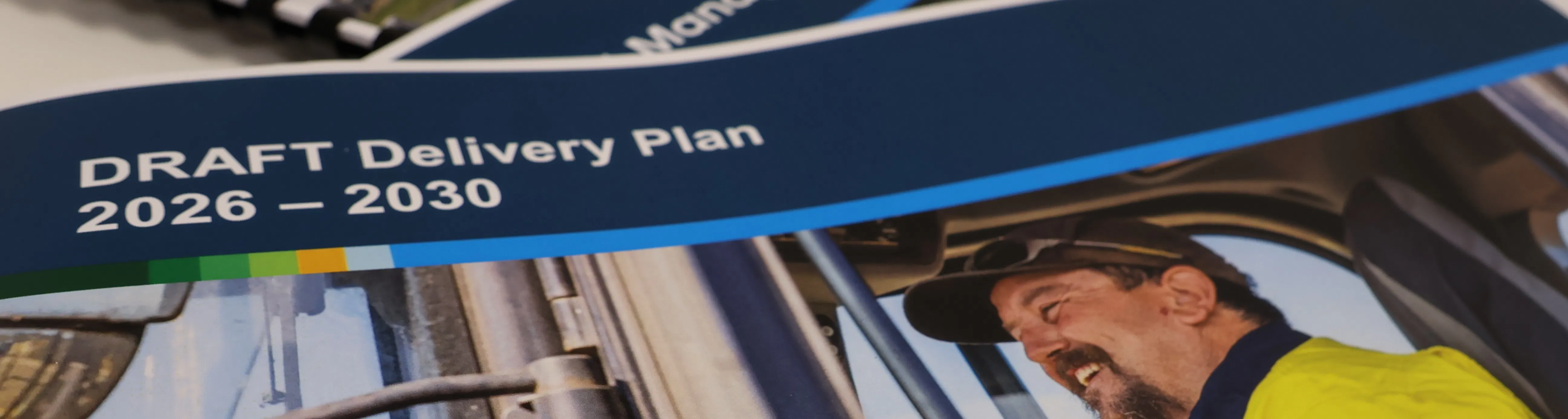
The Delivery Plan details the services and projects Council will deliver over the next four-years. It is the result of rigorous planning and prioritisation and aims to provide the best value services to the community. The Delivery Plan outlines what Council is committed to delivering in the next 4 years. It includes a detailed capital works plan and projected operational budgets from 2026-2030.
The Integrated Planning and Reporting Framework outlines that Councils are to develop a 4-year Delivery Program and 1 year Operational Plan. Council has evolved its planning practices and now fully integrates these two documents into a single Delivery Plan that covers a 4-year period. The Delivery Plan is structured around the different roles that Council plays- Deliver, Collaborate and Advocate.
What is the Resourcing Strategy?
The Resourcing Strategy is comprised of four separate documents: the Long Term Financial Plan, Workforce Strategy, Digital Services Strategy and Strategic Asset Management Plan.
These four separate, yet integrated documents detail the money, people, assets and systems Council will need to deliver services for the community.
The Digital Services Strategy 2025-2029 and Workforce Strategy 2025-2029 remain current and are scheduled for review in 2028-2029.
Long Term Financial Plan
The Long Term Financial Plan (LTFP) is compiled using a range of estimates and assumptions to project the future revenue and expenditure required by Council to deliver the services and projects we have planned. These estimates and assumptions are based on what we know now and will change as we understand more about the external impacts on our plans.
The LTFP helps to make informed decisions about what we can afford and when we need to invest funds to keep services running smoothly, avoid running out of cash and to ensure future generations are considered.
The LTFP includes 3 scenarios for the general fund; Scenarios A, B and C. These scenarios show differing levels of services and projects that can be achieved aligned with the income needed to make it possible. The draft Delivery Plan assumes the adoption of scenario C as Council’s budget. Scenarios A and B need significantly more funding. The LTFP identifies potential funding pathways for scenarios A and B to illustrate the requirements for a more ambitious delivery program.
Strategic Asset Management Plan
Council manages and maintains more than $2 billion worth of assets, which enable us to provide services to our community. These assets include roads, drainage, pathways, water and sewer infrastructure, community facilities, parks and recreational facilities, administration buildings, cemeteries, works depots, plant and vehicle fleet and the Merimbula Airport. The level of service delivered by these assets is largely determined by the way they are maintained and operated within Council’s available resources.
The Strategic Asset Management Plan (SAMP) sets out the broad framework for undertaking structured and coordinated management of Council’s assets in accordance with Council’s Asset Management Policy. It outlines key principles that underpin our approach to providing the assets that are essential to our community. Supporting the SAMP are detailed Asset Management Plans (AMP’s) for each asset class, which are living documents that are continually updated and refined. Summaries of the AMP’s are included in the SAMP.
The SAMP must be considered in conjunction with the Long Term Financial Plan that outlines the available funding under three different revenue scenarios. Aligned with those three revenue scenarios are three different capital programs to describe what asset maintenance, renewal and upgrades can be achieved within each option.
What is the Revenue Policy?
The Revenue Policy outlines Council’s rating structure and the annual rates and charges to be applied in the next financial year. It also includes detail on pensioner concessions, borrowings, debt recovery and reserves revenue and allocation. Supply charges for water, sewer, waste and on-site sewer management are also outlined.
What are Fees and Charges?
The fees and charges for various Council services are reviewed annually and presented to the community to review before they are applied for the next financial year. The increase in fees and charges are aligned with increases in the Consumer Price Index, rate peg or other statutory increases and reflect Council’s pricing policy.
What is Integrated Planning and Reporting?
The Integrated Planning and Reporting (IP&R) framework changed the way Councils in NSW planned, documented and reported on their plans for the future. The Framework came into practice in 2009 and many councils have refined the way they create and review these plans over the subsequent years. The following pages and links provide information on what the Framework involves and how to implement it.
In essence the IP&R Framework begins with the community’s, not councils, aspirations for a period of at least 10 years. It includes a suite of integrated plans that set out a vision and goals and strategic actions to achieve them. It involves a reporting structure to communicate progress to Council and the community as well as a structured timeline for review to ensure the goals and actions are still relevant.
https://www.olg.nsw.gov.au/councils/integrated-planning-and-reporting/